Winter Work Is Quiet on Purpose: A Smarter Marketing Season
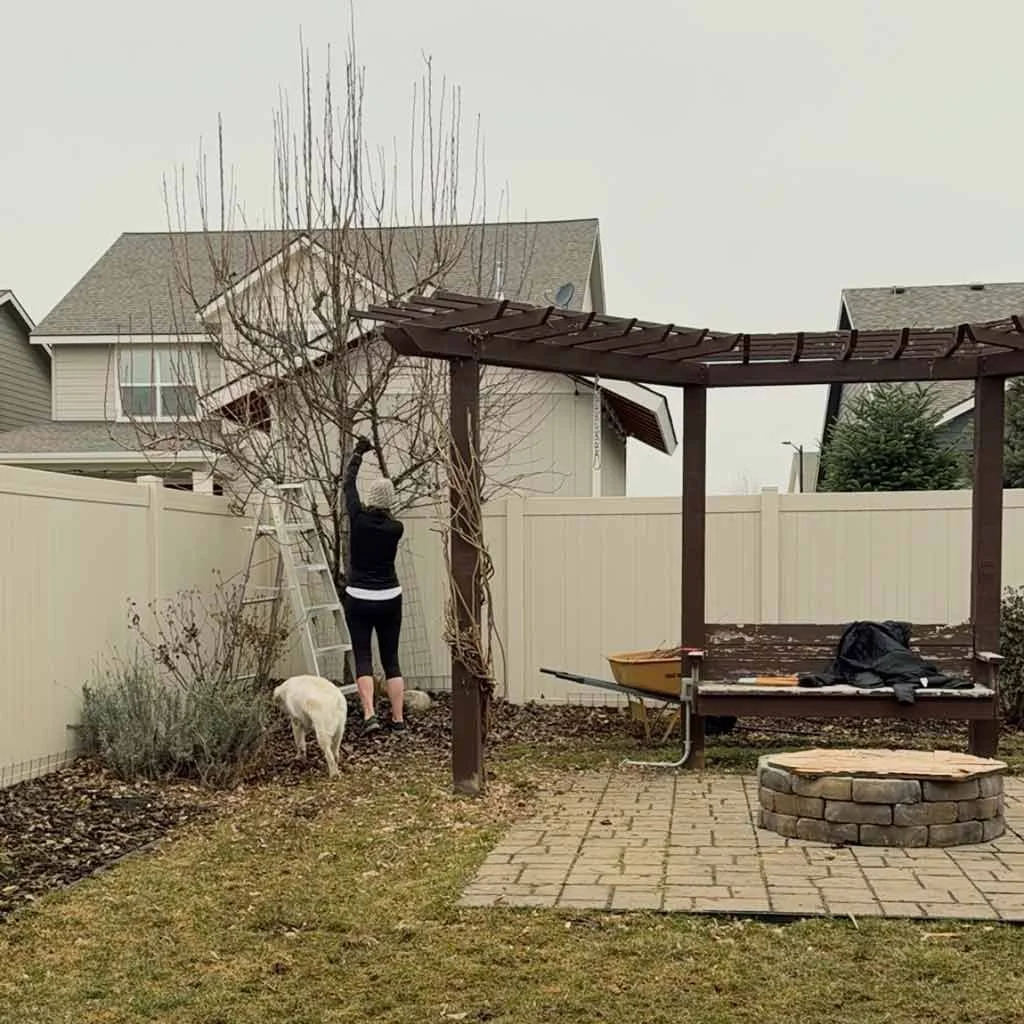
Me (Kristi) tackling my outsized pear tree
Early February in the Inland Northwest has a way of blurring the lines between seasons. A few warmer days sneak in. The light shifts just enough to make you believe spring might be close.
That’s what sent me outside last weekend, clippers and saw in hand, to finally do my winter pruning.
I started with my wisteria, where winter pruning is a must according to all of the gardening experts. It’s been in the ground for four years now and still hasn’t bloomed, but hope is still alive. Then I moved on to my multi-varietal pear and apple trees. And this year, I didn’t hold back.
In previous seasons, my pruning had been scattered. A little summer trimming here, some winter cuts there. The result was less than desirable: a pear tree that grew far too tall and an apple tree with branches stretching across two fences, producing fruit I could barely reach.
As I cut them back—harder than I ever had before—I kept saying the same thing out loud:
I don’t want trees where I have to harvest the fruit from a ladder.
It struck me how familiar that feeling was. Because that’s exactly how many small business owners describe their marketing—productive, but increasingly out of reach. (If you’re curious, you’ll find the ‘after’ photo of my pear tree at the end of the article 😅.)
Why does winter feel uncomfortable in business?
Quick summary: Winter slows momentum and removes distractions, making it easier to see what’s overgrown, misaligned, or no longer serving the business.
Winter pruning is rarely enjoyable. It’s cold (here at least). It’s methodical. And when done properly, it can look extreme. But it’s also essential for healthy growth later on.
In business, “winter” doesn’t always align with the calendar. For some retail businesses, it does. For others, winter is simply the slower or quieter season—the time when launches pause, demand eases, or visibility dips.
What makes this season difficult isn’t the slowdown itself. It’s the pressure layered on top of it.
The pressure to keep every offer running.
To stay visible on every platform.
To maintain momentum at all costs.
When things slow down, there’s nowhere to hide from what’s been growing unchecked. And that’s often where discomfort turns into clarity.
What does pruning actually mean for a small business?
Quick summary: Pruning means intentionally pausing, removing, or refining what no longer supports your goals, your clients, or your capacity.
In the garden, pruning isn’t about cutting for the sake of cutting. It’s about directing energy where it matters most.
In business, pruning serves the same purpose.
It might look like:
Letting go of an offer that creates complexity without meaningful return
Pausing a marketing channel that consumes time but doesn’t convert
Simplifying messaging that’s accumulated layers over the years
Reducing the number of initiatives competing for attention
This is where many business owners hesitate. Cutting feels risky. Keeping everything alive feels safer—even when the evidence suggests otherwise.
That tension—between maintaining everything and knowing something needs to change—is often the first signal that it’s time to step back and look more closely.
Not to overhaul everything. Not to make dramatic moves. Just to ask better questions about what still fits the stage your business is in.
We often talk with local business owners who reach this point quietly, usually in a slower season, when there’s finally enough space to reflect. If that sounds familiar, this overview of how we work can help you decide whether outside marketing support makes sense right now.
→ Is Rinehart Marketing right for your local small business?
How do metrics make pruning easier?
Quick summary: Clear marketing metrics replace fear-based decisions with informed ones, making it easier to pause or cut tactics without second-guessing.
This is where winter becomes especially useful—because it creates distance.
One of the hardest parts of marketing decision-making is not knowing whether you’re cutting something prematurely or simply acknowledging what the data has been saying all along.
Recently, we reviewed a client’s fall ad campaigns that included Black Friday. We looked closely at conversion rates and ROI across platforms. The results were clear: Google Ads tied to an entry-level offer were converting better than Facebook ads.
So we paused Facebook spend and shifted to a cyclical investment in Google Ads.
It wasn’t a decision made lightly. There was some risk involved. But there was also relief—the kind that comes from seeing the situation clearly.
When you understand where conversions are actually coming from, pruning stops feeling like loss and starts feeling like alignment.
If you’re unsure how well your website is supporting your marketing right now, winter is a low-pressure time to review it. Our Free Website Audit Checklist helps surface early signals worth paying attention to.
Why winter is ideal for behind-the-scenes work
Quick summary: Winter creates the space to improve systems and processes without the pressure of immediate visibility or output.
Once spending, channels, and offers are clearer, attention naturally shifts inward.
Winter has a way of revealing friction—not just in what you’re promoting, but in how the work actually gets done.
At Rinehart Marketing, we intentionally use this season to review systems and processes. This winter, that’s included:
Streamlining analytics and reporting workflows
Improving content creation processes
Using AI thoughtfully to reduce time spent on repetitive tasks
Refining prospecting systems
I also used this time to conduct a full audit of our website—tightening messaging on our home and services pages to better reflect how we work today and introducing clearer next steps for visitors. We reviewed our Google Business Profile as well, making sure categories, service descriptions, and updates were aligned and current.
None of this work is particularly visible. But all of it directly affects capacity, clarity, and the quality of what comes next.
You might find it useful during this quieter season to spend about 10 minutes completing our free Brand Refresh Scorecard to discover where your brand is strong—and where it’s not:
Or if your website or marketing foundation hasn’t been reviewed in a while, winter is often the least disruptive time to do it. Our project work offers a straightforward starting point, including marketing consults and brand or digital presence audits at an accessible price point.
How winter work changes the feel of spring
Quick summary: When winter is used well, spring growth feels steadier, more intentional, and easier to support.
When systems are simplified and decisions are sorted, the effects aren’t immediately visible from the outside—but they’re deeply felt inside the business.
That’s what makes spring feel different.
Because of the work done this winter, we’re heading into the next season with:
Refreshed content that appeals to our ideal clients
Clearer messaging across services
More streamlined internal processes
Capacity to take on new business without scrambling
Growth feels lighter when it’s built on intention rather than accumulation.
If part of your winter reset includes budgeting or planning for the year ahead, this resource can help you approach it intentionally:
→ Marketing Budgets Made Easy: A Step-by-Step Guide for Very Small Businesses
Where might your business need pruning?
Quick summary: Pruning opportunities often show up where effort is high, complexity is growing, and results are inconsistent or unclear.
As you reflect on your own “winter,” consider:
Which efforts consistently demand energy without meaningful return?
Where has complexity crept in gradually?
What would feel like relief to pause, simplify, or refine?
Pruning isn’t about shrinking your ambition. It’s about making room for what can actually flourish.
A quiet invitation
Winter is quiet on purpose.
It’s not a failure state. It’s not a holding pattern. It’s the season that invites you to observe closely, decide carefully, and prepare with intention.
If a marketing-related project emerges from your winter reset—whether that’s auditing your website, refining your strategy, or simplifying what you’re carrying—we’re here to help.
You can explore whether our approach is a fit here:
→ Is Rinehart Marketing right for your local small business?
Sometimes the most confident move you can make is designing your business so the fruit stays within reach—no ladder required.
Want to talk through your winter project? Let’s connect!

My pear tree after pruning. Hoping no ladder will be needed to reach the fruit!